
BUILDING ENVELOPE
How moisture moves through your home, why it matters, and the right strategy for keeping your building envelope dry.

The best strategy for controlling moisture in your home depends on your climate and how your home is constructed. Before deciding on a moisture control strategy, you need to understand how moisture moves through a home.
Moisture control strategies typically include these areas of a home:
In most U.S. climates, you can use vapor-diffusion retarders in these areas to control moisture. Proper ventilation should also be part of a moisture-control strategy.
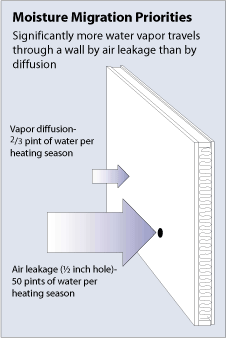
An air barrier / vapor-diffusion retarder controls both air leakage and moisture diffusion through the building envelope. A proper balance between insulation, air sealing, and vapor management produces a more comfortable, healthier home environment.
Moisture or water vapor moves in and out of a home in three ways:
Air movement accounts for more than 98% of all water-vapor movement in building cavities. Air naturally moves from a high-pressure area to a lower one by the easiest path possible — generally through any available hole or crack in the building envelope. Moisture travels with the air.
Diffusion through materials and heat transfer are much slower processes. Most common building materials slow moisture diffusion to a large degree, although they never stop it completely. Insulation also helps reduce heat transfer or flow.
The laws of physics govern how moist air reacts within various temperature conditions. As air warms, its capacity to hold water vapor increases; as air cools, that capacity decreases. Insulation moderates the effect of temperature across the building-envelope cavity.
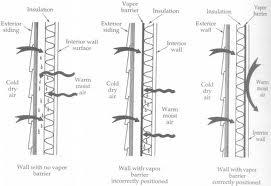
A vapor barrier or vapor-diffusion retarder (VDR) is a material that reduces the rate at which water vapor can move through it. The older term “vapor barrier” is still used, even though it may inaccurately imply the material stops all moisture transfer.
The ability of a material to retard the diffusion of water vapor is measured in units known as “perms.” A perm at 73.4°F (23°C) measures the number of grains of water vapor passing through a square foot of material per hour at a differential vapor pressure of 1 inch of mercury.
After managing rainwater, the next most important job of a building enclosure is controlling air leakage. An effective air barrier reduces energy loss, prevents condensation inside wall cavities, and improves comfort and indoor air quality. Pair it with the right vapor-diffusion retarder for your climate, and the envelope works as designed.
Most homeowners overpay because no one diagnosed the real problem first. Let’s fix that.