
AIR SEALING & INSULATION
You can reduce your home’s heating and cooling costs through proper insulation and air sealing techniques. These techniques will also make your home more comfortable.
Any air sealing efforts will complement your insulation efforts, and vice versa. Proper moisture control and ventilation strategies will improve the effectiveness of air sealing and insulation, and vice versa.
Stop uncontrolled air leakage through cracks and openings to cut energy waste and improve comfort.
Slow heat transfer through walls, ceilings, and floors so your home holds its temperature.
Manage water vapor and condensation to protect framing and indoor air quality.
Provide controlled fresh air so your home breathes safely without uncontrolled leakage.
A proper balance between all of these elements will result in a more comfortable, healthier home environment.
Air leakage, or infiltration, occurs when outside air enters a house uncontrollably through cracks and openings. Properly air-sealing such cracks and openings can significantly reduce heating and cooling costs, improve building durability, and create a healthier indoor environment.
It is unwise to rely on air leakage for ventilation because it can’t be controlled. During cold or windy weather, too much air may enter the house. When it’s warmer and less windy, not enough air may enter. Air infiltration also can contribute to problems with moisture control. Moldy and dusty air can enter a leaky house through such areas as attics or foundations.
The recommended strategy in both new and old homes is to reduce air leakage as much as possible and to provide controlled ventilation as needed.
Sealing and insulating the “envelope” or “shell” of your home — its outer walls, ceiling, windows, doors, and floors — is often the most cost effective way to improve energy efficiency and comfort. ENERGY STAR estimates that a knowledgeable homeowner or skilled contractor can save up to 20% on heating and cooling costs by air-sealing the home and adding insulation in attics, floors over crawl spaces, and basements.
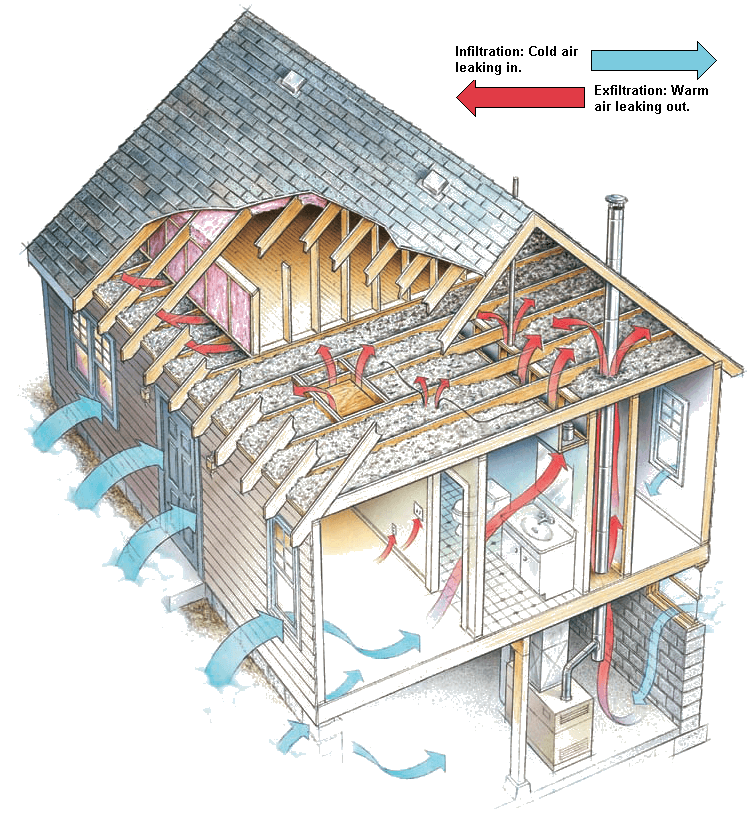
Next to rain, air leaks through walls, roofs, and floors can have a huge effect on the durability of a house. Uncontrolled air flow through the shell can carry moisture into framing cavities — causing structural deterioration — and account for a very large portion of a home’s energy use.
Energy efficiency requires a tight shell and good indoor air quality. In “leaky” homes, large volumes of air — driven by exhaust fans, furnace fans, the stack effect, and wind — can blow through the home’s floor, walls, and ceiling. Because air usually contains water vapor, these uncontrolled air leaks can cause condensation. Homes need an adequate air barrier and a controlled ventilation path.
An air barrier consists of materials assembled and joined together to prevent air leakage between the conditioned space and the unconditioned space — that is, indoors and outdoors. Some products — for example, drywall, plastic, or housewrap — are considered air barriers, but when building scientists talk about a home’s air barrier, they’re not talking about a single material; they’re talking about a complete system.
A typical air barrier incorporates more than a dozen materials: poured concrete; sill seal; wall sheathing; housewrap; contractors’ tape; caulk; spray foam; gaskets; window glass; insulation, vapor barrier, and weatherstripping.

Get an honest diagnosis from a Guardian Home Advisor — we’ll walk your envelope, identify the leaks and weak insulation that are costing you, and lay out exactly what to fix and what to leave alone.
Most homeowners overpay because no one diagnosed the real problem first. Let’s fix that.